What Every Buyer Must Understand Before Installation
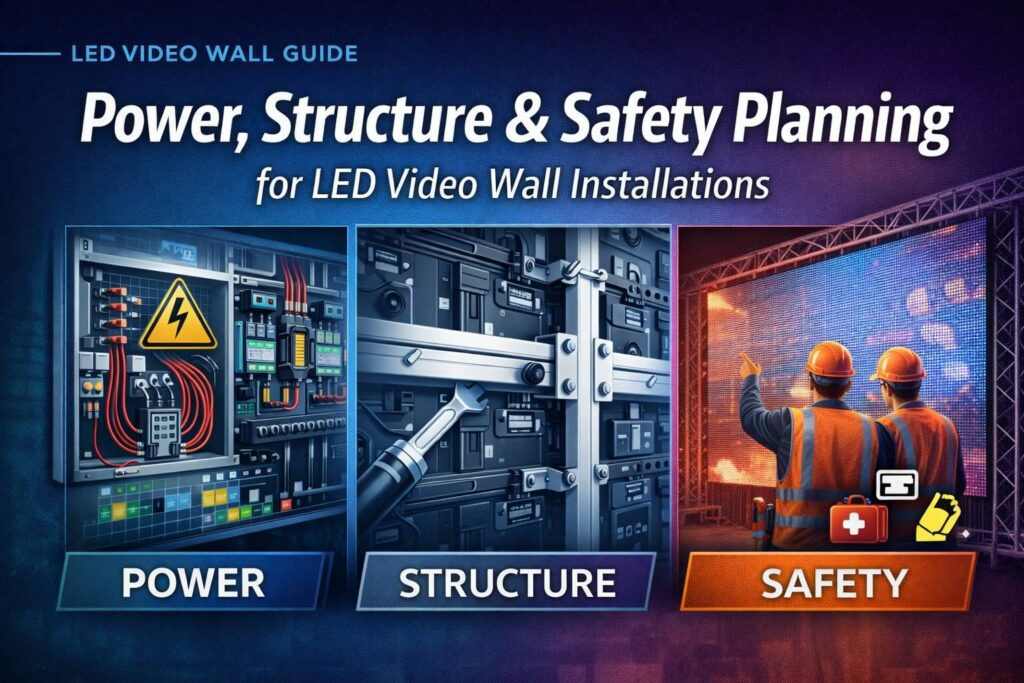
An LED video wall is not just a display — it is a high-power electrical system, a structural installation, and a safety-critical asset.
Many project delays, budget overruns, and operational failures happen not because of the LED panels themselves, but because power planning, mounting structure, and safety requirements were underestimated.
This guide explains what you need to know to plan your LED video wall correctly and avoid costly mistakes.
⚡ 1️⃣ Electrical Power Planning
🔌 How Much Power Does an LED Video Wall Use?
Power consumption depends on:
- Pixel pitch
- Brightness level
- Content type
- Cabinet efficiency
- Ambient temperature
Typical ranges:
- Indoor LED wall: 400–800 watts per square meter (max)
- Outdoor LED wall: 800–1,500 watts per square meter (max)
Real-world usage is usually 40–60% of maximum power during normal operation.
🔋 Circuit Capacity & Load Balancing
Important considerations:
- Dedicated circuits are required
- 20A circuits typically support ~1,900 watts safely
- Power must be evenly distributed across cabinets
- Redundancy is recommended for mission-critical systems
Poor power planning can lead to:
❌ Tripped breakers
❌ Voltage drops
❌ Flickering displays
❌ Equipment damage
🛡️ Power Protection & Redundancy
Recommended protections:
- Surge protection
- UPS backup for control systems
- Dual power supplies (where supported)
- Grounding compliance
This protects your investment from power instability.
🏗️ 2️⃣ Structural & Mounting Considerations
🧱 Wall Load & Structural Integrity
LED walls can weigh:
- 20–40 lbs per square meter (indoor)
- 40–70+ lbs per square meter (outdoor)
Key questions:
- Can the wall support the load?
- Is steel reinforcement required?
- Are anchors rated properly?
- Is seismic compliance needed?
A structural assessment prevents liability risks.
📐 Mounting Options
Common mounting systems:
- Wall-mounted frame
- Floor-supported structure
- Truss systems (events)
- Ceiling suspension
- Custom steel framing
Each option impacts:
- Cost
- Installation time
- Maintenance access
- Safety compliance
🔧 Service Access & Maintenance
Design must allow:
- Front or rear service access
- Module replacement clearance
- Cable routing space
- Ventilation airflow
Poor access increases downtime and labor cost.
🌡️ 3️⃣ Heat Management & Ventilation
LED walls generate heat during operation.
Heat risks:
- Reduced LED lifespan
- Color shift
- Power supply failure
- Premature aging
Solutions:
- Passive airflow design
- Active ventilation
- Temperature monitoring
- Adequate spacing behind cabinets
Never enclose LED walls without thermal design.
🧯 4️⃣ Safety & Compliance Requirements
🧾 Electrical Compliance
Must follow:
- NEC (National Electrical Code)
- Local building codes
- Fire safety regulations
- Grounding standards
Permits may be required for permanent installations.
🚨 Fire Safety
Consider:
- Fire-rated materials
- Cable management
- Emergency power shutdown
- Access clearance
- Smoke pathways
🦺 Personnel Safety
Installation safety includes:
- Fall protection
- Lift equipment
- Lockout procedures
- PPE usage
- Load certification
Professional installers mitigate these risks.
🌧️ 5️⃣ Outdoor Environmental Protection
Outdoor installations require:
- Weatherproof cabinets (IP65+)
- UV protection
- Drainage planning
- Wind load analysis
- Lightning protection
- Temperature tolerance
Improper outdoor planning leads to early failure.
📋 6️⃣ Pre-Installation Planning Checklist
Before installation, confirm:
✔ Available power capacity
✔ Circuit layout
✔ Load calculations
✔ Mounting method
✔ Structural approval
✔ Ventilation strategy
✔ Safety compliance
✔ Maintenance access
✔ Permit requirements
✔ Future expansion plans
This checklist avoids expensive rework.
❌ 7️⃣ Common Planning Mistakes
Avoid:
- Assuming existing power is sufficient
- Ignoring wall structural limits
- Blocking service access
- Skipping permits
- No redundancy planning
- No thermal strategy
These mistakes cost far more than proper planning.
🏗️ 8️⃣ Why Professional Engineering Matters
A professional integrator provides:
✔ Site survey
✔ Power load calculations
✔ Structural design
✔ CAD drawings
✔ Permit coordination
✔ Installation safety
✔ Commissioning & testing
✔ Documentation
This protects your investment and your organization.
📞 Plan Your Project Safely
Pixel Wall provides:
- Electrical load analysis
- Structural assessment
- Safety compliance planning
- Installation engineering
- Long-term support
👉 Request a free site evaluation and build your LED video wall the right way.
About Pixel Wall:
Pixel Wall is a professional LED video wall design, installation, and event solutions provider serving Virginia, Washington DC, and Maryland. We specialize in delivering reliable, code-compliant, and high-performance LED video wall systems for enterprise, government, and event environments.